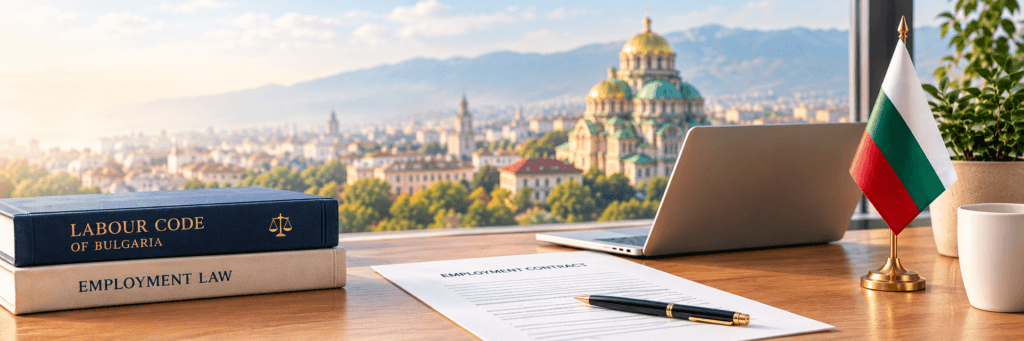
If you’re planning to hire in Bulgaria, the first thing you’ll notice is how different everything feels from what you’re used to. Bulgarian labor law is detailed, employee-protective, and largely non-negotiable. You can’t simply borrow a US or UK style offer letter and call it a day. Every hire, whether it’s your first or your fiftieth, has to sit inside a legal framework that was built to protect workers first and give employers a clear, if narrow, set of rules to follow.
This guide breaks down what actually matters. No legal jargon for the sake of it, just the parts of Bulgarian labor code that determine whether your hiring process holds up or creates a headache six months down the line.
Why Bulgarian Labor Law Catches Foreign Employers Off Guard
Bulgaria’s Labour Code (Кодекс на труда) applies to any employment relationship performed on Bulgarian soil, no matter where the employer is headquartered. That means if you’re a company in Berlin, Austin, or London hiring someone based in Sofia or Plovdiv, Bulgarian labor law governs that relationship in full. There’s no opting out by writing your own contract terms. You can read the full text of the Labour Code on Bulgaria’s official legal information portal, though it’s dense reading without local context.
What trips people up isn’t the existence of the rules. It’s how specific and mandatory they are. Minimum annual leave, working hours, notice periods, and severance triggers are all fixed by statute. You can offer more than the minimum, but you can never offer less, even if both sides agree to it in writing.
Employment Contracts Bulgaria: What Must Be in Writing
This is the part employers get wrong most often. Under Bulgarian labor law, employment contracts must be in writing and signed before the employee’s first day, not after. A verbal agreement, an email confirmation, or a “we’ll formalize it later” approach isn’t just risky, it’s technically a violation that can trigger administrative fines.
A compliant contract needs to include, at minimum:
- The employer and employee’s full identification details
- Job title, duties, and workplace location
- Start date and contract duration (indefinite or fixed-term)
- Gross salary and any additional pay components
- Working hours (standard is 8 hours a day, 40 hours a week)
- Annual leave entitlement (20 working days minimum)
- Notice period for termination
Once signed, the contract must be registered with the National Revenue Agency (NRA) within three working days of the start date. Skipping this step is one of the most common compliance failures foreign employers make, and it’s an easy one to avoid with the right local support.
A Quick Look at Contract Types
| Contract Type | Best For | Key Feature |
|---|---|---|
| Indefinite | Long-term, permanent roles | Default type under Bulgarian labor law |
| Fixed-term | Project work, seasonal roles | Max duration and renewal limits apply |
| Part-time | Reduced hours arrangements | Pro-rated leave and benefits |
| Remote work agreement | Distributed or hybrid teams | Must specify equipment, expenses, and data protection terms |
Bulgaria Hiring Compliance: The Non-Negotiables
Getting the contract right is only step one. Bulgaria hiring compliance also covers payroll, social contributions, and how you handle employees once they’re on board.
Here’s what that looks like in practice:
- Social security contributions: Employers contribute roughly 18.92% to 19.62% of gross salary, covering pension, health, unemployment, and occupational accident insurance. Employees separately contribute around 13.78%.
- Personal income tax: A flat 10% rate applies, one of the lowest in the EU, which is part of why Bulgaria has become an attractive hiring destination.
- Monthly filings: Payroll declarations and payments are due to the NRA by the 25th of the following month. Missing this deadline brings interest charges and penalties.
- Workplace safety training: Mandatory for new hires before they start actual duties, and enforced by the Executive Agency “General Labour Inspectorate”, which can inspect any workplace employing foreign nationals.
None of this is optional, and none of it can be handled retroactively without cost. This is exactly the kind of detail that gets lost when a company tries to manage Bulgarian hiring from abroad without local expertise.
Hiring Non-EU Nationals
If you’re bringing in talent from outside the EU, EEA, or Switzerland, there’s an extra layer. Non-EU nationals need both a work permit and a residence permit before they can legally start. The employer typically has to run a labor market test first, proving no suitable Bulgarian or EU candidate is available for the role. Highly qualified professionals may qualify for an EU Blue Card instead, which skips the labor market test and moves faster.
You can find official guidance on this process through the Bulgaria Employment Agency, which issues the permits, and the Ministry of Labour and Social Policy, which publishes English-language guidance for foreign employers.
Termination and Notice Periods
Bulgarian labor law doesn’t allow at-will termination. Employers need documented cause, and the standard notice period is one month, though contracts can specify up to three. Severance obligations vary depending on the termination reason and can range from one to several months’ salary. Getting this wrong is one of the fastest ways to end up in a labor dispute, and Bulgarian courts tend to favor the employee when documentation is thin.
Remote Work Has Its Own Rules Too
Since 2020, remote and home-based work has been formally recognized under Bulgarian labor law. If you’re hiring someone to work remotely, the arrangement needs to be spelled out in writing, covering the work location, hours, equipment responsibilities, and data protection measures. Remote employees carry the same statutory protections as anyone working from an office, so there’s no shortcut here either.
Getting It Right From the Start
Bulgarian labor law rewards employers who take the details seriously and penalizes the ones who don’t. Between mandatory contract terms, strict registration deadlines, and specific rules for remote and non-EU hires, there’s a lot to track, especially if this is your first hire in the country.
That’s where working with people who handle this every day makes the difference. At Perpetum, we manage the entire employment relationship for foreign companies hiring in Bulgaria, from compliant contracts to payroll and ongoing HR administration, so you can focus on building your team instead of decoding statute.